Why Systems Matter: From Everyday Tasks to Real-World Workspaces
Updated: May 18

In many environments—whether at home, in a garage, or on a job site—things often appear functional on the surface. Tools are present. Supplies are available. Tasks get completed.
But beneath that surface, there’s often friction.
Time is lost searching for what should be within reach. Tasks take longer than they should. Tools are duplicated, misplaced, or underused. Safety becomes reactive instead of consistent. And over time, the environment begins to feel harder to maintain rather than easier to use.
The difference between a space that works and one that constantly requires effort isn’t more equipment—it’s better systems.
The Problem: When Everything Exists, But Nothing Works Together
Most people don’t struggle because they lack tools or resources. They struggle because those tools aren’t working together in a structured way.
A yard may have everything needed for maintenance, but if equipment is scattered or difficult to access, even simple tasks become time-consuming. A workshop may be well-equipped, but without a defined layout, productivity slows and frustration builds.
Safety equipment may be available, but if it isn’t consistently used or easy to access, it becomes an afterthought.
This is where small inefficiencies begin to compound:
Repeating the same setup process every time a task begins
Buying duplicate tools because the original can’t be found
Avoiding tasks altogether because they feel more complicated than they should
Overlooking safety in the interest of speed or convenience
These issues don’t come from a lack of effort. They come from a lack of structure.
The Shift: Thinking in Systems Instead of Individual Pieces
A system is not a collection of items. It’s the way those items work together to support a task from start to finish.
When a system is in place, the environment becomes easier to use—not because there is more available, but because everything has a clear purpose, location, and role.
This shift in thinking changes how decisions are made.
Instead of asking:
“What do I need to buy?”
The question becomes:
“What system am I building, and what supports it?”
Instead of adding more tools, the focus moves toward selecting tools that work together. Instead of reorganizing repeatedly, the goal becomes creating a structure that holds over time.
This approach applies across environments—from everyday home maintenance to professional workspaces.
How Systems Show Up in Real Environments
While the idea of systems may seem abstract, it becomes very practical when applied to real-world settings.
Yard and Outdoor Maintenance
Outdoor work is often one of the clearest examples of where systems matter. Equipment such as mowers, trimmers, and basic hand tools are commonly used, but without a defined setup, they can be difficult to access, store, or maintain.
A simple system might include:
Grouping tools by function
Storing equipment near where it is used
Creating consistent storage for fuel, batteries, or attachments
When these elements are structured, routine maintenance becomes faster and easier to start.
Tool Systems and Equipment
In many spaces, tools are collected over time rather than selected intentionally. This leads to drawers filled with overlapping items, inconsistent quality, and limited portability.
A system-based approach focuses on:
Fewer, more versatile tools
Consistent platforms (such as shared battery systems)
Organized storage that allows tools to be found and returned easily
This reduces clutter, improves efficiency, and makes tools more useful in practice—not just in theory.
Workspace Design and Flow
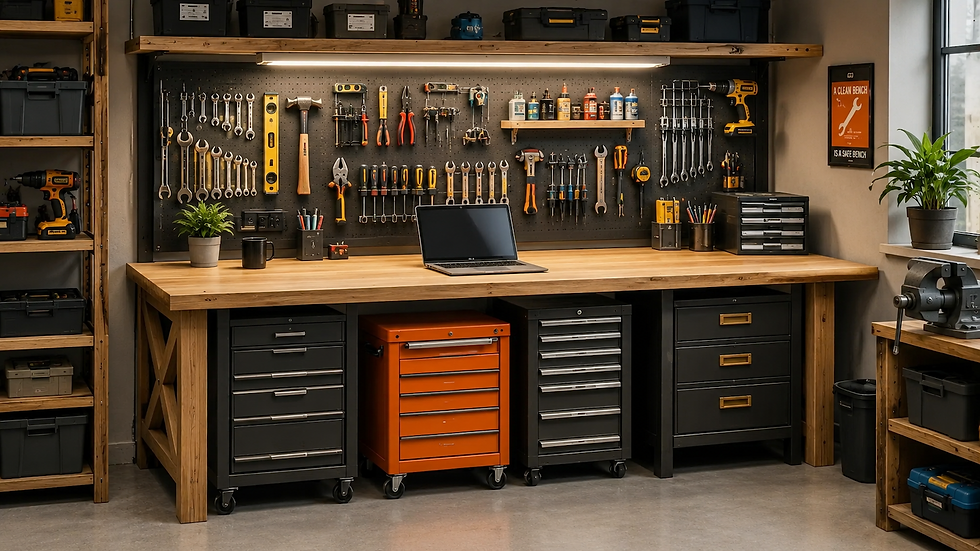
A workspace doesn’t need to be large to be effective, but it does need structure.
Without defined zones, tasks overlap and interfere with one another. Work surfaces become cluttered. Movement becomes inefficient.
A structured workspace typically includes:
A clear work area
Dedicated storage for frequently used items
Easy access to tools needed for current tasks
This creates flow—allowing work to move forward without unnecessary interruption.
Safety as Part of the System
Safety is often treated as something separate from the task itself, but in well-designed environments, it is built into the system.
Protective equipment is stored where it is needed. It is easy to access and becomes part of the routine rather than something added only when conditions feel risky.
This consistency reduces the likelihood of oversight and supports safer outcomes without slowing work down.
Preparedness in Everyday Environments
Preparedness does not require extreme measures. In most cases, it comes down to having simple, reliable systems in place.
This might include:
Organized storage for essential items
Accessible lighting solutions
Backup options for common disruptions
When these elements are integrated into the environment, they provide support without requiring constant attention.
Simple Principles That Make Systems Work
Across all environments, effective systems tend to follow a few consistent principles:
Keep access simple and visible
Items that are difficult to reach or see are less likely to be used consistently.
Store items where they are used
Reducing movement reduces friction and saves time.
Choose versatility over specialization
Fewer, more capable tools are easier to manage and maintain.
Prioritize consistency over perfection
A system that works regularly is more valuable than one that is occasionally ideal.
Adjust when needed, not constantly
Systems should evolve, but they should not require continuous rebuilding.
Building Systems That Last
The goal of any system is not to create a perfect environment. It is to create one that supports consistent, repeatable use over time.
When systems are in place, tasks become easier to begin and easier to complete. Tools serve a purpose rather than adding complexity. Workspaces support the work instead of slowing it down.
This approach reduces effort, improves outcomes, and creates environments that are easier to maintain—not just for a moment, but long-term.
In the end, systems are not about having more. They are about making better use of what is already there—and building environments that work with you, not against you.