Why Fewer, Better Tools Create Stronger Systems
Updated: Jun 6
Start Here
Many people assume that more tools automatically lead to better results.
In reality, the opposite is often true.
As collections grow, so do the challenges of storage, maintenance, organization, training, and decision-making. Systems become more complicated, workspaces become more crowded, and valuable time is spent managing equipment instead of using it.
Strong systems are often built around a carefully selected set of tools that perform reliably, serve multiple purposes, and integrate smoothly into the workflow.
Before reading, consider whether your current tools are improving your system—or making it more difficult to manage.
Ask Yourself These Questions:
Which tools do I use consistently, and which ones rarely leave storage?
How much time do I spend organizing, maintaining, or searching for equipment?
Are there multiple tools performing nearly the same task?
Which tools deliver the greatest value relative to the space they occupy?
Would a smaller collection of higher-quality tools improve efficiency and consistency?
Where has tool accumulation created complexity instead of capability?
If I were building my system from scratch today, which tools would I choose to keep?
Why It Matters
The strongest systems are not built around owning the most equipment. They are built around selecting the right equipment, maintaining it well, and integrating it into a workflow that remains efficient over time.
Fewer tools often mean fewer decisions, less maintenance, better organization, and more consistent results. When every tool has a purpose and a place, the entire system becomes easier to use, maintain, and improve.
In many workspaces—whether in a garage, workshop, or outdoor setup—it’s common to see tools collected over time.
A drill from one brand. A second drill from another. Multiple sets of hand tools, each slightly different. Specialized items purchased for a single task and rarely used again.
At first, this seems practical. More tools should mean more capability.
But over time, the opposite often happens.
The space becomes harder to manage. Tools are more difficult to find. Decisions take longer. And instead of supporting the work, the collection begins to slow it down.
The issue isn’t having tools. It’s having too many tools that don’t work together.
Stronger systems aren’t built by adding more. They’re built by choosing better.
The Problem: Tool Overload Without Structure
Tool overload doesn’t usually feel like a problem at the beginning. Each purchase makes sense on its own.
A new tool solves a specific need. A backup seems like a good idea. A specialized item promises to make a task easier.
But without a system behind those decisions, the collection grows in ways that create friction:
Tools are stored in multiple locations
Similar items overlap in function
Quality varies from one tool to the next
Accessories and attachments don’t align
Over time, this leads to a workspace where:
Finding the right tool takes longer than expected
Transporting tools between tasks becomes inefficient
Maintenance becomes inconsistent
Storage becomes more complex than necessary
The result is not increased capability—it’s reduced efficiency.
The Shift: From Tool Collection to Tool System
A tool system is not defined by how many tools are available. It is defined by how well those tools work together.
Instead of thinking in terms of individual items, a system-based approach focuses on:
compatibility
consistency
versatility
This changes how tools are selected.
Instead of asking:
“Do I need this tool?”
The question becomes:
“Does this tool strengthen the system I already have?”
This shift reduces unnecessary purchases and leads to a more cohesive, functional setup.
Why Fewer Tools Often Work Better
Having fewer tools may seem limiting, but in practice, it often creates more efficiency.
Less Time Spent Searching
When the number of tools is reduced and each has a defined place, finding what you need becomes faster and more consistent.
There are fewer decisions to make and fewer locations to check.
More Consistent Performance
Using a smaller set of reliable tools leads to more predictable results.
Instead of adjusting to different tools for similar tasks, the same tools are used repeatedly, building familiarity and confidence.
Easier Storage and Organization
Fewer tools mean simpler storage systems.
Instead of trying to manage a large, inconsistent collection, storage can be designed around a focused set of items that are used regularly.
Reduced Maintenance
Maintaining a smaller number of high-quality tools is more manageable than maintaining a large collection of mixed-quality items.
This leads to tools that last longer and perform better over time.
The Power of Modular Tool Systems
One of the most effective ways to build a strong tool system is through modular setups.
These systems are designed so that multiple tools share common components, such as batteries, attachments, or accessories.
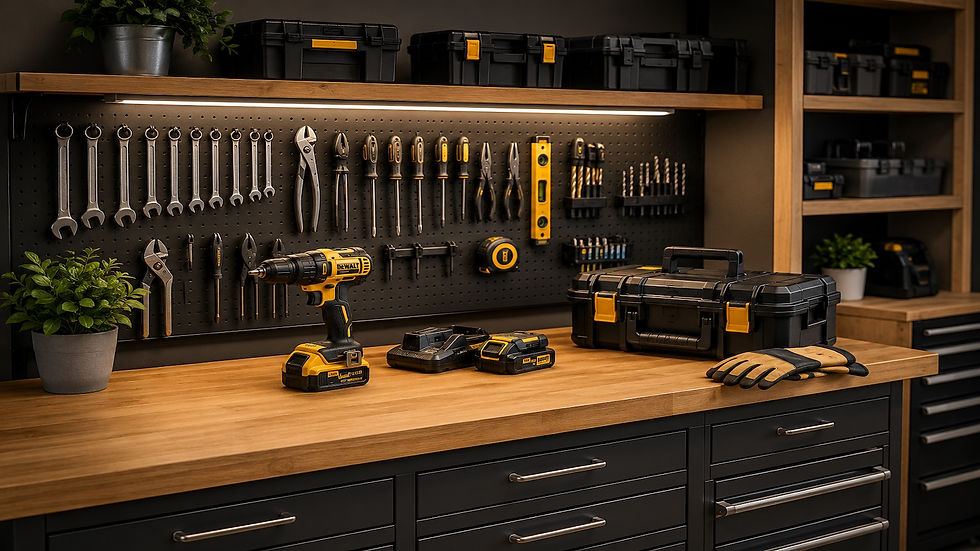
A common example is a cordless tool platform where:
drills, drivers, saws, and other tools use the same battery system
chargers are interchangeable
accessories are designed to work across multiple tools
This approach creates several advantages:
fewer components to manage
easier portability
consistent performance across tools
Instead of managing multiple independent tools, the system becomes integrated.
Portability and Consistency in Real Work
In many environments, tools are not used in a single fixed location.
Work moves between:
indoor and outdoor spaces
different areas of a property
job sites or project locations
A system built around fewer, compatible tools makes this movement easier.
Instead of transporting large, disjointed collections, a smaller, more cohesive set of tools can be moved efficiently.
Consistency also plays a role.
When tools operate similarly—using the same batteries, controls, or accessories—there is less need to adjust between tasks. This reduces errors and improves workflow.
Avoiding the Trap of Over-Specialization
Specialized tools have their place, but they often become part of the problem when used without a system in mind.
Many specialized tools:
serve a single purpose
are used infrequently
require separate storage and maintenance
Over time, they add complexity without providing consistent value.
A system-based approach prioritizes:
tools that serve multiple functions
tools that are used regularly
tools that integrate with existing equipment
This doesn’t eliminate specialization—it simply ensures that it is used intentionally.
Simple Principles for Building a Better Tool System
Strong tool systems are built on a few key principles:
Choose compatibility over variety
Tools that work together create stronger systems than tools that operate independently.
Prioritize versatility
Tools that can handle multiple tasks reduce the need for additional items.
Limit duplication
Multiple versions of the same tool often create more confusion than benefit.
Focus on quality over quantity
A smaller number of reliable tools is more effective than a larger collection of inconsistent ones.
Build gradually and intentionally
Systems improve over time when each addition is made with a clear purpose.
Doing More With Less
The idea of “more tools equals better results” is easy to believe, but in practice, it often leads to the opposite outcome.
More tools create:
more decisions
more storage challenges
more maintenance
more potential for disorganization
Fewer, better tools reduce complexity.
They create environments where:
tasks are easier to start
tools are easier to manage
work flows more naturally
The goal is not to have less for the sake of minimalism. It is to have exactly what is needed—and to use it well.
Building Systems That Support the Work
A well-built tool system does more than organize equipment. It supports the way work is done.
It reduces friction, improves consistency, and allows tasks to move forward without unnecessary interruption.
Over time, this leads to:
more efficient workflows
better results
environments that are easier to maintain
In the end, stronger systems are not built by adding more tools. They are built by choosing the right tools—and making sure they work together.