The Hidden Cost of Disorganization (And How Simple Systems Fix It)
Updated: Jun 6
Start Here
Disorganization rarely looks expensive at first.
It often shows up in small ways: searching for what should be easy to find, repeating work, replacing things that already exist, delaying projects, or losing momentum because the next step is unclear.
Over time, those small interruptions become a real cost. They drain time, reduce consistency, increase frustration, and make even simple work feel harder than it needs to be.
Simple systems help fix the problem by giving tools, supplies, documents, and processes a clear place, purpose, and pattern.
Before reading, consider where disorganization may be costing more than you realize.
Ask Yourself These Questions:
Where do I lose the most time searching, sorting, or resetting?
Which tools, supplies, or documents are hardest to find when I need them?
Where am I buying replacements because I cannot locate what I already own?
Which spaces or processes create the most friction before work even begins?
What part of my system depends too much on memory?
Where would labels, zones, checklists, or designated storage reduce repeated decisions?
What simple system would save the most time or frustration if I created it this week?
Disorganization is often viewed as a visual problem.
A cluttered workspace. A crowded garage. Tools stacked in drawers or spread across surfaces. It’s easy to look at these environments and assume the issue is simply “too much stuff.”
But the real cost of disorganization isn’t how it looks—it’s how it functions.
It shows up in lost time, repeated purchases, unnecessary frustration, and even increased risk. Over time, these small inefficiencies compound, turning simple tasks into things that feel harder than they should be.
The goal isn’t to create perfectly clean spaces. It’s to create environments that work—consistently, efficiently, and with less effort.
The Problem: When Disorganization Becomes Normal
In many environments, disorganization doesn’t happen all at once. It builds gradually.
A tool is set down “for now” and never returned to a defined place. A new item is purchased because the original can’t be found. Storage becomes temporary instead of intentional.
Over time, this leads to environments where:
Items exist, but aren’t easy to access
Tasks require setup before they can even begin
Tools are scattered across multiple locations
Workspaces feel harder to maintain than to use
Because this happens slowly, it often becomes normalized. The extra time, effort, and frustration are accepted as part of the process.
But they don’t have to be.
The Real Cost: More Than Just Clutter
Disorganization creates friction. And friction shows up in ways that go far beyond appearance.
Wasted Time
One of the most immediate impacts is time.
When tools, materials, or supplies aren’t where they should be, even simple tasks require extra steps:
searching
moving items out of the way
resetting the space before starting
These delays may seem small, but they add up quickly—especially when repeated daily or weekly.
Duplicate Tools and Equipment
Disorganization often leads to unnecessary purchases.
When something can’t be found, it’s easier to replace it than to continue searching.
Over time, this creates:
multiple versions of the same tool
inconsistent quality
more items to store and manage
Instead of solving the problem, this increases it.
Safety Risks
In work environments—whether at home or in a more professional setting—disorganization can also impact safety.
When tools are left out, stored improperly, or difficult to access:
hazards are easier to overlook
protective equipment is less likely to be used
workspaces become less predictable
Safety becomes reactive instead of consistent.
Mental Load and Frustration
Disorganization doesn’t just affect physical space—it affects how that space feels to use.
Environments that lack structure often create:
hesitation before starting a task
frustration during simple processes
a sense that things are harder than they should be
This mental load can lead to avoiding tasks altogether, even when they are straightforward.
The Shift: From Clutter to Structure
The solution to disorganization isn’t constant cleaning or reorganization. It’s structure.
Instead of focusing on removing items, the focus shifts to how those items are used, stored, and accessed.
This is where systems come in.
A system creates:
a clear place for each item
a defined role for each tool
a consistent way to begin and complete tasks
When structure is in place, the need for constant resetting is reduced. The environment begins to maintain itself.
How Simple Systems Fix the Problem
Systems don’t need to be complex to be effective. In fact, the most effective systems are often the simplest.
They are designed to reduce friction—not add to it.
Tool Organization That Supports Use
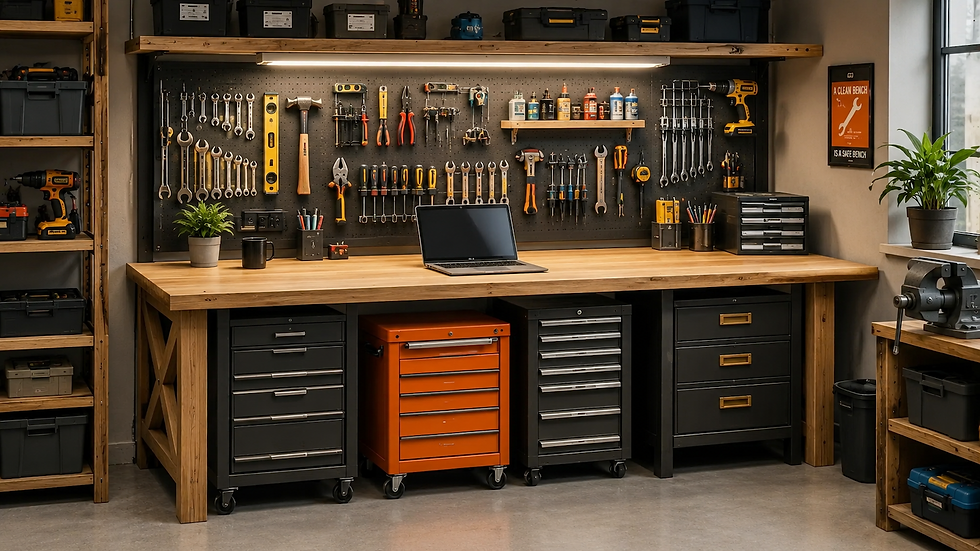
Instead of storing tools wherever space is available, systems group tools based on how they are used.
This might include:
keeping frequently used tools within immediate reach
storing related tools together
using simple, visible storage instead of closed or hidden spaces
This reduces search time and makes it easier to return tools after use.
Consolidation Instead of Expansion
One of the most effective ways to reduce disorganization is to avoid unnecessary duplication.
Rather than accumulating multiple specialized items, systems focus on:
versatile tools that serve multiple purposes
consistent platforms (such as shared batteries or attachments)
fewer, higher-quality options
This simplifies both storage and use.
Workspaces Designed for Flow
A structured workspace makes it easier to move from one step to the next without interruption.
This includes:
a clear work surface
defined storage areas
easy access to frequently used items
When flow is built into the environment, tasks require less setup and less cleanup.
Storage That Reflects Real Use
Storage systems are most effective when they match how items are actually used—not how they “should” be stored.
This means:
placing items where they are needed, not where space is available
prioritizing accessibility over appearance
keeping frequently used items visible and easy to reach
When storage aligns with behavior, consistency becomes easier.
Simple Principles That Reduce Disorganization
Across different environments, a few principles consistently lead to better outcomes:
Keep systems simple
Complexity makes systems harder to maintain.
Make access easy
If something is difficult to reach, it won’t be used consistently.
Reduce duplication
Fewer tools mean fewer decisions and less clutter.
Return items immediately
Systems only work when they are used consistently.
Build around real habits
Systems should support how tasks are actually performed, not ideal scenarios.
Doing More With Less
Disorganization often leads to the assumption that more is needed—more tools, more storage, more space.
In reality, the opposite is usually true.
When systems are in place:
fewer tools are required
less space is needed
tasks become easier to manage
The focus shifts from accumulation to intention.
Instead of managing more, the goal becomes using what you have more effectively.
Building Environments That Work
The purpose of organization is not to create a perfect space. It is to create one that supports consistent, efficient use over time.
When systems replace disorganization:
tasks start faster
tools are easier to use and maintain
workspaces support the work instead of slowing it down
The result is an environment that requires less effort to maintain and delivers better results in return.


