How Different Systems Work Together in Real-World Environments
Updated: May 18

In most environments—whether at home, in a garage, or across a workspace—things are rarely limited to a single category.
Tools are used alongside storage systems. Workspaces rely on lighting and organization. Safety equipment supports how tasks are completed. Outdoor tools connect to maintenance and property care.
Yet these elements are often treated as separate decisions.
A tool is chosen on its own. Storage is added later. Safety is considered when needed.
Over time, this creates environments where everything exists—but nothing works together as efficiently as it could.
The difference between a space that functions smoothly and one that feels inconsistent isn’t the number of items within it. It’s how well those items are connected.
Strong environments are built on systems.
The Problem: When Everything Is Separate
Many setups develop over time without a clear structure.
A tool is added when needed. Storage is placed wherever space allows. Equipment is selected based on immediate use rather than long-term fit.
Individually, these decisions make sense. But collectively, they create disconnect.
This often leads to:
tools that don’t align with storage systems
workspaces that require constant setup
safety equipment that isn’t consistently used
outdoor systems that operate independently from indoor workflows
The result is friction.
Tasks take longer to begin. Movement between steps becomes inefficient. Items are harder to find and harder to return. Over time, the environment becomes something that requires effort to manage instead of something that supports the work.
The Shift: From Individual Choices to Connected Systems
A system is not defined by what is included. It is defined by how those elements work together.
This requires a shift in perspective.
Instead of asking:
“What do I need for this task?”
The question becomes:
“How does this fit into the system I’m building?”
This approach creates alignment.
Tools are selected based on compatibility. Storage is designed around use. Safety becomes part of the process rather than something added later. Outdoor and indoor systems begin to support one another.
The result is not more complexity—it is less.
How Systems Connect in Real Environments
Systems become easier to understand when viewed through real-world application.
Tools and Storage Working Together
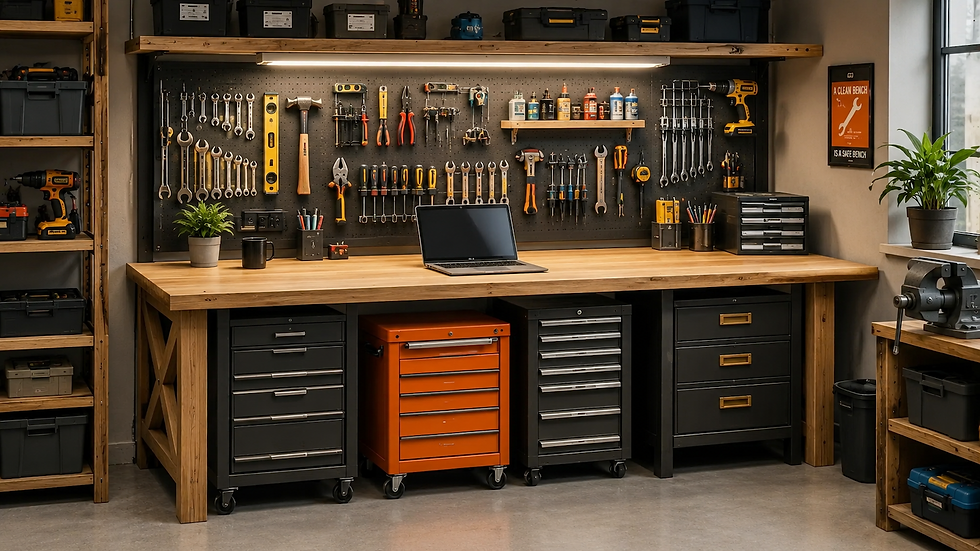
Tools are most effective when they are easy to access, easy to return, and easy to maintain.
When tools and storage are disconnected:
tools are stored in multiple locations
frequently used items are difficult to reach
organization requires constant effort
When they are connected:
tools are stored based on use
related items are grouped together
access becomes consistent and predictable
This reduces time spent searching and improves overall workflow.
Workspaces and Flow
A workspace is not just a surface—it is part of a system.
Without structure, workspaces become:
cluttered
inefficient
difficult to use consistently
When aligned with surrounding systems:
tools are within reach
materials are accessible
movement between steps is smooth
Flow improves when each part of the environment supports the next.
Safety as an Integrated Element
Safety is often treated as something separate from the task itself.
But in well-structured environments, it is built into the system.
When safety is disconnected:
protective equipment is not always used
access requires extra steps
consistency is difficult to maintain
When safety is integrated:
equipment is stored at the point of use
visibility reinforces habit
protection becomes part of routine
This creates safer environments without adding complexity.
Outdoor and Indoor Systems
Many environments extend beyond a single space.
Outdoor tools, maintenance equipment, and property systems often operate independently from indoor setups.
When disconnected:
equipment is stored inefficiently
movement between spaces is inconsistent
tasks feel fragmented
When aligned:
storage supports both indoor and outdoor use
tools move easily between environments
maintenance becomes more predictable
This connection reduces redundancy and improves usability.
Why Disconnected Systems Create Friction
When systems are not aligned, small inefficiencies begin to compound.
These may include:
repeated setup before tasks
unnecessary movement between areas
duplicate tools or equipment
inconsistent use of safety measures
Individually, these issues may seem minor. Over time, they increase effort and reduce efficiency.
Friction is rarely caused by a lack of tools or resources. It is caused by a lack of connection between them.
Simple Principles for Building Connected Systems
Creating alignment does not require complex planning. It requires a few consistent principles:
Group items by use, not category
Tools, storage, and safety equipment should support the same tasks.
Design around movement
Consider how tasks flow from one step to the next.
Keep access simple
Items that are easy to reach are more likely to be used consistently.
Reduce unnecessary duplication
Fewer, better-integrated items create stronger systems.
Adjust based on real use
Systems should reflect how tasks are actually performed.
Building Environments That Work Together
A well-functioning environment is not defined by how much it contains. It is defined by how well it works as a whole.
When systems are connected:
tasks become easier to start
workflows become more consistent
tools and equipment are easier to manage
The goal is not to create separate areas that function independently. It is to create an environment where each part supports the others.
Over time, this reduces effort, improves reliability, and creates spaces that are easier to maintain.
In the end, systems are not just about organization. They are about connection—and how that connection supports the way work is done every day.