More Tools, More Problems: Why Expanding Your Setup Often Reduces Performance
Updated: May 18

Adding more tools feels like progress.
It usually isn’t.
Expansion creates the impression of increased capability—more options, more specialization, more ways to handle different situations. But in practice, it often introduces complexity that reduces performance instead of improving it.
The issue isn’t the tools themselves. It’s what happens to the system around them.
Complexity Builds Faster Than Capability
Every new tool adds more than function.
It adds:
A storage decision
A maintenance requirement
A point of retrieval
A variation in workflow
Individually, these are small. Collectively, they create friction.
As complexity increases, consistency decreases. And consistency is what allows systems to perform reliably.
The Illusion of Being Better Equipped
A larger setup can feel more complete.
But more tools don’t automatically translate to better outcomes.
In many cases:
The right tool isn’t immediately accessible
The number of choices slows decision-making
Overlap between tools creates confusion
Instead of improving efficiency, the system becomes harder to navigate.
Performance Depends on Clarity
High-performing systems are clear.
You know where things are
You know what to use
You know how to use it
When too many tools are introduced, that clarity starts to fade.
The system becomes less predictable. And when predictability is lost, performance drops.
The Hidden Cost of Expansion
The cost of a tool isn’t just the purchase.
It’s:
The space it occupies
The time it takes to manage
The impact it has on the rest of the system
Expansion increases all of these, often without delivering proportional benefit.
Fewer Tools, Stronger Systems
Reducing the number of tools doesn’t reduce capability—it concentrates it.
Fewer tools:
Are easier to store
Are easier to maintain
Are easier to rely on
They create systems that are more consistent and easier to use under real conditions.
What This Looks Like in Practice
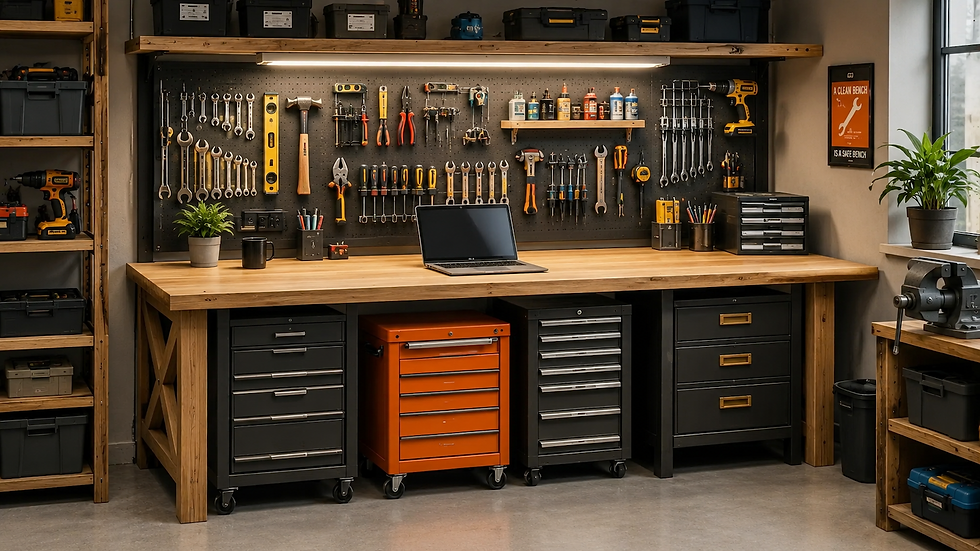
A streamlined setup is not minimal for the sake of appearance.
It is selective.
Each tool has a clear role
Overlap is reduced
Access is straightforward
The result is a system that supports action instead of slowing it down.
Expansion Should Be Intentional
Adding a tool should solve a problem—not create new ones.
Before expanding, it’s worth asking:
Does this improve the system, or complicate it?
Will this be used regularly, or occasionally?
Does this replace something, or add to it?
If the answer adds complexity without improving consistency, it may not belong in the system.
More tools can create the appearance of progress. Stronger systems are built through clarity, not accumulation.