Advanced Workflow Design: How Systems Scale Over Time
- Linda Watson

- Apr 24
- 4 min read
A workspace that functions well today may not function well tomorrow.
As tools are added, projects become more complex, and tasks expand, the demands placed on a space begin to change. What once felt efficient can start to feel crowded, inconsistent, or difficult to maintain.
This is not a failure of the space itself. It is a result of growth without structure.
Most environments are designed for current use. Few are designed to adapt.
Advanced workflow design focuses on something different—not just how a space works now, but how it continues to work as demands increase over time.
The Problem: When Growth Creates Friction
Many workspaces begin with a simple setup.
A defined work area, basic storage, and a small set of tools are enough to support early tasks. But as more is added, the system begins to stretch.
This often leads to:
overcrowded work surfaces
storage that no longer aligns with use
tools that are difficult to access or return
movement patterns that become inefficient
Instead of improving capability, growth introduces friction.
Tasks require more setup. Movement becomes less direct. Maintaining the space requires more effort than using it.
The issue is not expansion—it is expansion without a system that supports it.
The Shift: Designing for Change, Not Just Use
A functional workspace supports current tasks.
An effective system supports change.
This requires a different approach to design.
Instead of asking:
“How should this space be set up?”
The better question becomes:
“How will this space adapt as it grows?”
This shift allows systems to evolve without needing constant rebuilding.
It creates environments that remain stable even as they expand.
Core Elements of Scalable Systems
Scalable systems are not more complex—they are more intentional.
They are designed with flexibility, consistency, and future use in mind.
Modular Structure
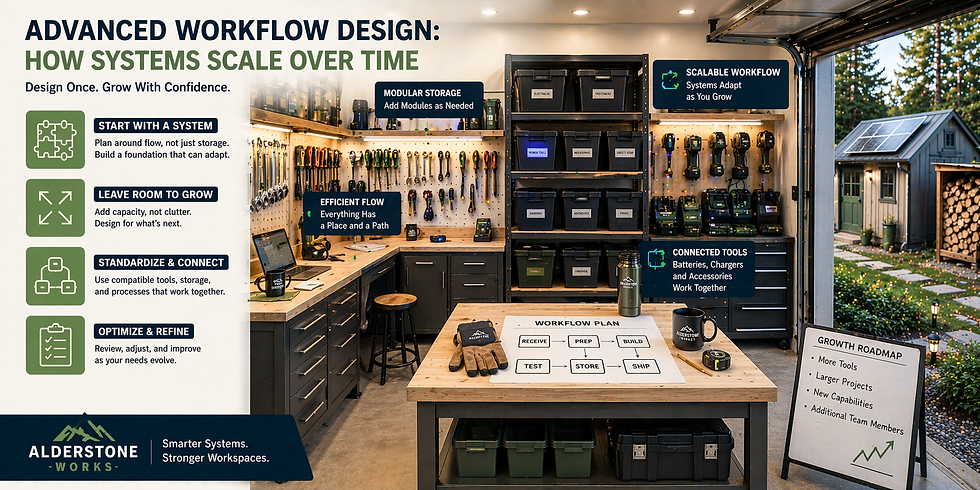
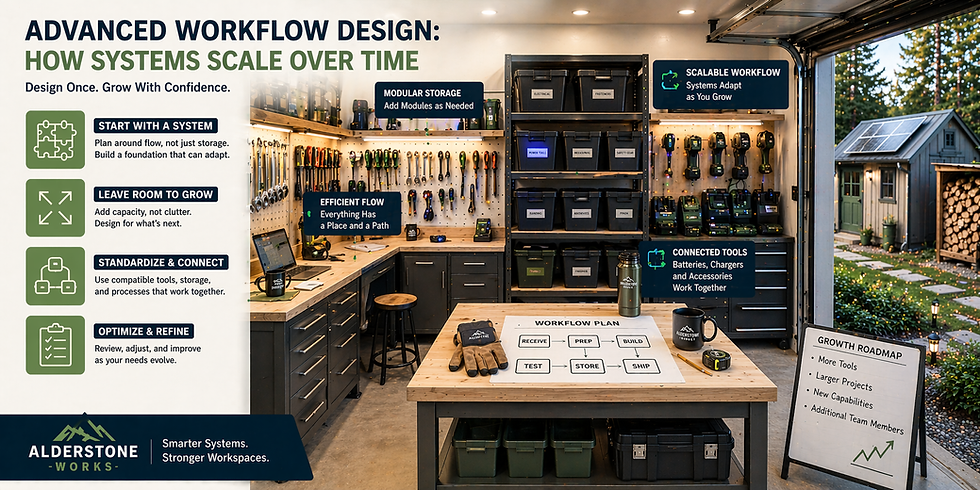
Modular systems allow components to be added, removed, or adjusted without disrupting the entire setup.
This might include:
adjustable storage systems
expandable work surfaces
interchangeable components
Modularity reduces the need for complete reconfiguration when new tools or tasks are introduced.
Defined Zones That Can Expand
Zoning remains important as systems grow.
However, in scalable environments, zones are not rigid—they are adaptable.
For example:
storage areas can extend vertically or horizontally
work areas can expand without interfering with movement
access pathways remain clear as additional elements are introduced
Defined zones provide structure. Flexible zones allow growth.
Consistent Systems Across Tools and Storage
Consistency becomes more important as complexity increases.
When tools, storage, and workflows follow consistent patterns:
decisions become easier
errors are reduced
maintenance becomes more predictable
This includes:
standardized storage methods
consistent tool platforms
repeatable organization systems
Consistency reduces friction as the system scales.
Space for Movement, Not Just Storage
One of the most common issues in growing environments is the loss of movement space.
As storage expands, pathways narrow. As tools increase, access becomes restricted.
Scalable systems protect movement by:
maintaining clear access paths
avoiding overcrowding
prioritizing usability over maximum storage
Movement is part of the system—not leftover space.
Planning for Growth Without Overbuilding
One of the challenges in designing scalable systems is finding balance.
Overbuilding creates unnecessary complexity. Underplanning creates future limitations.
The goal is not to anticipate every possible need. It is to create enough flexibility to adapt without disruption.
This can be achieved by:
leaving space for expansion
choosing systems that can be adjusted over time
avoiding fixed layouts that cannot evolve
Small allowances for growth prevent larger problems later.
Reducing Friction as Systems Expand
As environments grow, friction often increases unless it is actively managed.
Common sources of friction include:
overlapping tasks within the same space
tools stored far from where they are used
inconsistent organization methods
repeated setup and breakdown
Reducing friction requires:
reinforcing structure
maintaining consistency
adjusting systems based on real use
Growth should improve capability—not reduce efficiency.
Integrating Safety and Maintenance Into Scalable Systems
As systems expand, safety and maintenance become more important—not less.
Without integration:
safety practices become inconsistent
maintenance becomes reactive
risks increase over time
Scalable systems address this by:
maintaining visibility of safety equipment
ensuring access remains clear
integrating maintenance into regular workflow
This supports reliability as complexity increases.
Avoiding Common Scaling Mistakes
Many systems lose effectiveness as they grow due to a few common mistakes:
Expanding Without Structure
Adding tools, storage, or work areas without adjusting the system leads to disorganization.
Prioritizing Capacity Over Usability
Maximizing storage often reduces accessibility and movement, creating inefficiency.
Ignoring Consistency
Introducing new systems that don’t match existing ones increases complexity.
Rebuilding Instead of Adjusting
Constant reorganization creates instability. Scalable systems evolve without requiring complete resets.
Simple Principles for Scalable Workflow Design
As systems grow, a few principles help maintain structure:
Build with flexibility in mind
Choose systems that can adapt over time.
Maintain consistent organization methods
Consistency reduces complexity.
Protect movement and access
Usability should not be sacrificed for storage.
Expand gradually and intentionally
Growth should align with actual needs.
Adjust systems based on use, not assumption
Real-world use should guide changes.
Building Systems That Improve Over Time
A well-designed system does not become harder to manage as it grows. It becomes more effective.
When scalability is built into the design:
expansion feels natural
workflows remain consistent
environments continue to support the work
The goal is not to create a static space. It is to create one that evolves without losing structure.
In the end, advanced workflow design is not about complexity. It is about maintaining simplicity—even as systems expand.
When growth is supported by structure, the system continues to work—no matter how it changes over time.